Fat has had a complicated few decades.

For most of the late twentieth century it was the dietary villain — the thing you limited, avoided, and felt guilty about eating. Low-fat everything followed: low-fat yoghurt, low-fat salad dressing, reduced-fat crackers, fat-free dairy that tasted vaguely of sadness. The food industry obliged enthusiastically, replacing fat with sugar and starch and calling the result healthier.

Then the research shifted. The fat-phobia narrative began to unravel. Dietary fat, it turned out, was not the primary driver of the health outcomes it had been blamed for. The picture was considerably more complicated — and considerably more interesting — than "fat bad, avoid it.

"Most people today have absorbed some version of this revision. "Not all fats are bad" is now a reasonably mainstream idea. But the revision has mostly stopped there, at a vague permission to stop being afraid of avocado. What it has not produced is a cleaner, more useful way to actually evaluate the fat in any given food from a nutrition label.

That is what this post is about.
- The problem with grams of fat
- Why calories are the right denominator for fat too
- Fat density as a descriptor, not a verdict
- The quality layer: what fat density cannot tell you
- An honest admission about fat and eating like a functioning human
- The Fat Index
- Join the Newsletter
The problem with grams of fat
The fat line on a nutrition label gives you a number — grams of fat per serving, or per 100 grams. Most people look at this number, compare it to a threshold floating in their head, and make a judgment.
The problem is that grams of fat in isolation, like grams of protein in isolation, tells you almost nothing useful without knowing what those grams are costing you calorically.
Fat delivers 9 kilocalories per gram — more than twice the caloric value of protein or carbohydrates, which deliver 4 kilocalories per gram each. This means that fat is calorically dense by nature. A small quantity of fat contributes a significant number of calories. And this is exactly the information missing from a raw grams number.
Consider two foods:
A 30-gram serving of almonds contains approximately 14 grams of fat and 170 calories. A 100-gram serving of full-fat Greek yoghurt contains approximately 5 grams of fat and 97 calories.
On raw fat grams, almonds look dramatically higher. But this comparison is again mixing quantities — 30 grams of one food against 100 grams of another. Standardise by calories and the picture shifts: almonds deliver about 8.5 grams of fat per 100 kcal. Full-fat Greek yoghurt delivers about 5 grams of fat per 100 kcal.
Still different, but the gap is much smaller than the raw number suggested — and more importantly, it is now a fair comparison. You are comparing fat content at the same caloric cost, which is the only comparison that tells you anything meaningful about how these foods actually behave in your diet.
Why calories are the right denominator for fat too
The argument is the same as for protein: calories are the currency of your diet. Every food you eat costs calories. The question is what you are getting in return?
For fat specifically, the per-calorie comparison matters because fat’s caloric density makes it uniquely easy to misread on a label. A product that appears low in fat by weight — say, 8 grams per 100 grams — might still be delivering a substantial proportion of its calories from fat if its overall caloric density is modest. Conversely, a food that looks high in fat by weight might be delivering that fat at a very reasonable caloric cost if the food is otherwise lean.
Fat per 100 kcal strips away this ambiguity. It tells you, for every 100 kilocalories you consume of this food, how many grams of fat you are getting. That number is directly comparable across every food you will ever evaluate — a jar of nut butter, a piece of salmon, a packaged snack, a slice of cheese — regardless of serving size, water content, or overall caloric density.
Fat density as a descriptor, not a verdict
Here is where fat diverges from protein.
For protein, higher per-calorie density is unambiguously better. More protein per calorie means more satiety, more muscle maintenance support, and better nutritional return on your calorie investment. The direction is clear.
For fat, the direction is not clear — because fat density is a descriptor of what kind of food you are dealing with, not a judgment about whether it is good or bad.
A high fat density score means this food delivers most of its calories from fat. Whether that is desirable depends entirely on what the food is and what role it plays in your eating. Pure oils score at the ceiling of the Fat Index — essentially 100 percent of their calories come from fat. That is not a problem if you are using olive oil as a cooking medium or a dressing component. It becomes a problem only if you are consuming it in quantities that crowd out protein, fibre, and volume from your diet. Besides, who eats pure oil?
Almonds score high on fat density. So does avocado. So does cheddar cheese. And so do certain ultra-processed snack products built from industrial seed oils. The fat density score is identical or similar across these very different foods. What differentiates them is not the quantity of fat but the quality — and that is where the label requires a second look.
The quality layer: what fat density cannot tell you
This is the distinction that actually matters for health outcomes. The research that dismantled fat-phobia did not conclude that all fat is equally fine — it concluded that the blanket condemnation of dietary fat was wrong, and that fat quality is the more relevant variable than fat quantity.
Specifically: unsaturated fats — the kind found in olive oil, avocado, nuts, fatty fish, and most whole food fat sources — are associated with positive health outcomes. Saturated fats — found in dairy, red meat, coconut oil, and many processed products — are associated with more mixed evidence and are generally considered fine in moderate quantities from whole food sources. Trans fats — found in partially hydrogenated oils and many ultra-processed products — retain a genuine consensus around harm and are worth avoiding wherever they appear on an ingredient list.
Two foods can score identically on the Fat Index while being nutritionally very different. A piece of salmon and a bag of processed crackers built from palm oil might sit at similar fat densities per 100 kcal. The score is the same. The nutritional reality is not.
This is why the Fat Index calculator includes an optional saturated fat field. When the label lists saturated fat separately — which most Singapore labels do — entering it alongside total fat activates a secondary note that tells you what proportion of the fat is saturated. If saturated fat makes up more than half of total fat, the note flags it. Not as a verdict, but as context — because context is what the score alone cannot give you.
When the label does not list saturated fat separately, the ingredient list is your next check. If partially hydrogenated oil, hydrogenated vegetable fat, or palm oil appears early in the ingredients — particularly in a product where fat density is already high — that is worth knowing.
An honest admission about fat and eating like a functioning human
Here is something I will say plainly: fat is not optional.
I do not mean this in the hedged, qualified way that nutrition communication often delivers this message — “fat can be part of a healthy diet in moderation.” I mean it as a direct statement about physiology. Your body needs fat. It needs it to absorb fat-soluble vitamins. It needs it for hormone production. It needs it for brain function. And it needs it, frankly, for the eating experience to be satisfying enough that you actually maintain any kind of consistent dietary pattern rather than abandoning it three weeks in because everything tastes like cardboard.
Even if you eat extraordinary amounts of protein and fibre — and I do think these are the two most important variables to get right — your body will eventually register the absence of fat and make its displeasure known. It will do this through cravings, specifically the kind that send you straight toward the most fat-rich thing within reach and result in eating considerably more of it than you would have if you had simply integrated fat into your diet in the first place.
Integrate healthy fats. Do not shun them.
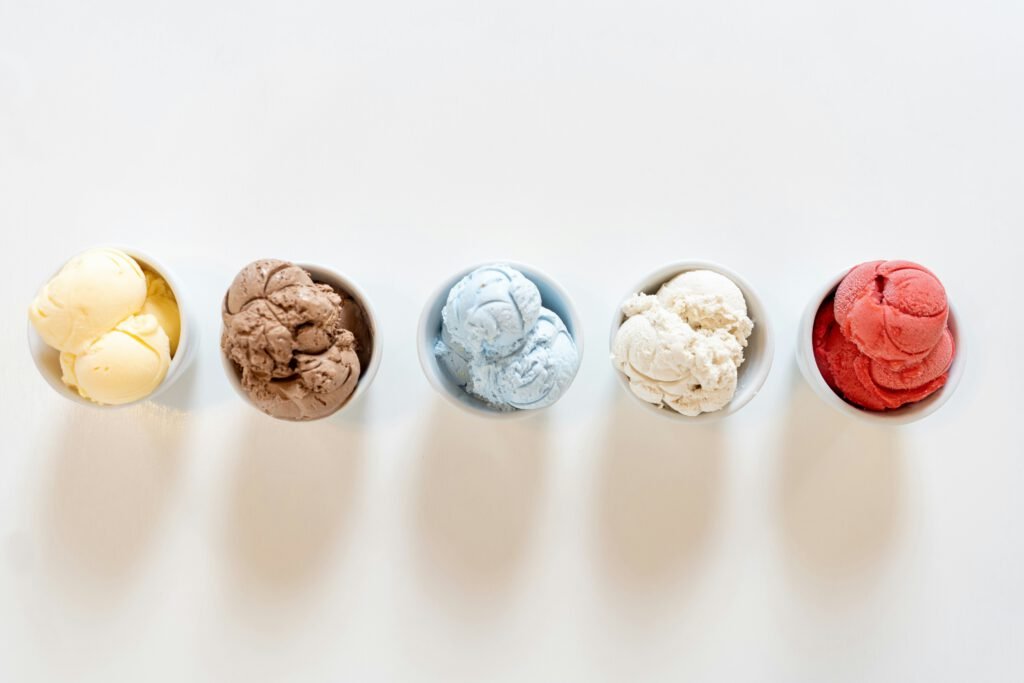
And while I am being honest: one of the things I look for specifically when evaluating a dessert is a high fat density alongside a low sugar score. A rich, creamy dessert — a good custard, a proper full-fat ice cream, a dense piece of cheesecake with real cream cheese — is going to satisfy in a way that a pure-sugar confection simply cannot. Compare it to cotton candy, which is essentially nothing but sugar and air. After eating it you feel as though you had nothing, because structurally you had almost nothing — no fat, no protein, no fibre, no physical substance to speak of. Whereas a smaller portion of something rich and fatty is going to make every part of your brain that tracks satiety believe that it has been genuinely fed.
This is not a permission slip to eat dessert constantly. It is an observation that when you do eat something sweet, the fat content is often the variable that determines whether it satisfies or merely extends the craving. A dessert that scores well on fat density and reasonably on sugar is usually a better choice than one that scores well on sugar and poorly on fat — not because fat is a health food, but because it is structurally more satisfying at a smaller quantity. That’s why I’m currently building the Dessert Index – in order to give you the calculator that already sits in my brain and with which I test desserts that catch my eye. It is built precisely with that logic in mind.
The Fat Index
The Label Brief’s Fat Index formalises the fat per calorie calculation into a 0 to 100 score using the same logarithmic curve as the Protein Index. The theoretical ceiling is approximately 11 grams of fat per 100 kcal — the point at which every calorie comes from pure fat — which scores 100. Pure oils sit at or very near this ceiling.
Unlike the Protein Index where a higher score is unambiguously better, the Fat Index is neutral. A high score means this food is fat-dense. A low score means it is not. The score positions the food on the fat density spectrum without rendering a verdict on it.
A note triggers above a score of approximately 83 — the point on the logarithmic curve where fat density is high enough that the quality question becomes the most relevant next check. At that point the calculator prompts you to look at the saturated fat figure and the ingredient list. Below that threshold the score stands on its own.
The calculator accepts total fat in grams and calories in kcal from the label directly, or fat per 100 kcal if you already know the ratio. The saturated fat field is optional — fill it in when the label provides it, leave it blank when it does not. The score is valid either way.
Run it on the next product where fat feels like the relevant variable — a dairy product, a packaged snack, a nut-based food, a cooking ingredient. The score will tell you where it sits. The saturated fat note and the ingredient list will tell you whether where it sits is a reason to think further.
The Fat Index calculator sits amongst The Calculators where you will also find the Protein, Sugar, Fibre, and Volume Indexes.
Join the Newsletter
Get the newest notes delivered to your email
.
SenT Only when there’s something worth sharing
the author

Mimi
founder
I experiment with building smarter eating habits that are relatively easy to implement and meant to help people feel better day to day and for the long-term.
Leave a Reply to Protein is everywhere. So why do most “high-protein” foods still fall short? – The Label Brief Cancel reply