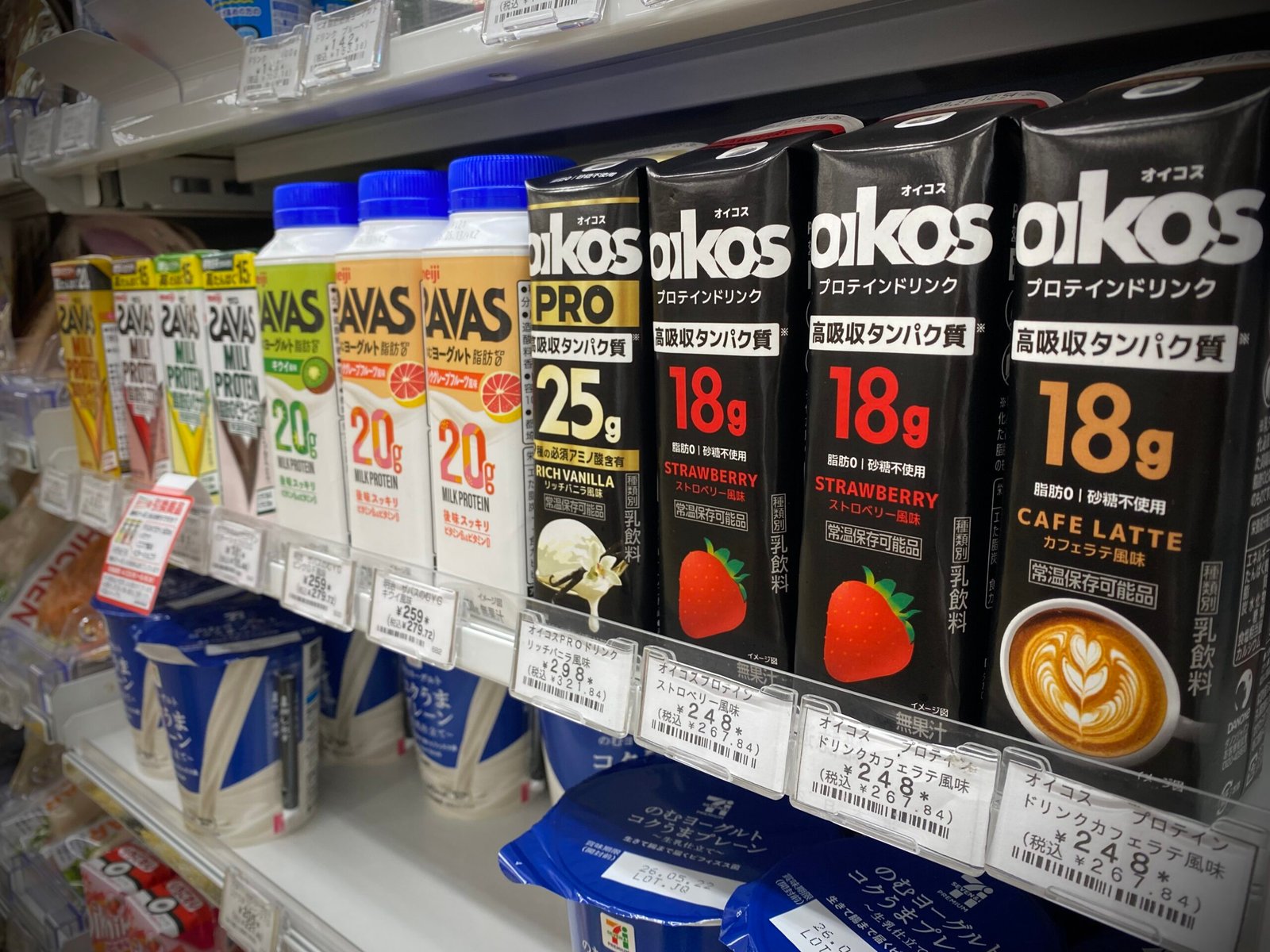
There is a number on almost every nutrition label that most people check, misread, and then use to make a decision that doesn't quite hold up.

The protein number.

Specifically: the grams of protein per serving, or per 100 grams, listed somewhere in the middle of the nutrition facts panel. People glance at it, compare it to whatever benchmark is floating around in their heads — is 6 grams good? is 20 grams high? — and then make a call. High protein, low protein, good choice, bad choice.

The problem is that grams of protein in isolation is one of the least useful ways to evaluate a food's protein content. And understanding why changes how you read every label from here on.
- The comparison problem
- Why calories are the only fair comparison
- The theoretical ceiling and what it means in practice
- What this looks like on a label
- How different foods actually score
- A brief and honest digression about volume
- The Protein Index
- Join the Newsletter
The comparison problem
Consider two foods:
A 30-gram serving of almonds contains approximately 6 grams of protein. A 100-gram chicken breast contains approximately 31 grams of protein.
On raw grams, chicken breast wins by a factor of five. But that comparison is doing something misleading – it is comparing different quantities of food. Of course 100 grams of anything contains more of most things than 30 grams of it. The comparison is not between almonds and chicken breast. It is between 30 grams of almonds and 100 grams of chicken breast. That is not a fair fight.
Standardise by weight — compare both per 100 grams — and the picture changes. Almonds contain about 21 grams of protein per 100 grams. Chicken breast contains about 31 grams per 100 grams. Closer, but chicken breast still wins clearly.
Now standardise by calories and the picture changes again in an interesting way.
Almonds deliver approximately 4 grams of protein per 100 kcal. Chicken breast delivers approximately 20 grams of protein per 100 kcal.
The gap widens dramatically. Not because almonds got worse, but because the calorie comparison reveals something the weight comparison obscured: almonds are calorie-dense. You are paying a significant calorie price for each gram of protein almonds deliver. Chicken breast delivers its protein at a much lower calorie cost.
Why calories are the only fair comparison
When you are trying to evaluate whether a food is a good source of protein, the question you are actually asking is
How much protein do I get for the calorie cost of eating this?
This is the right question because calories are the currency of your diet. Every food you eat costs calories. The question is what you are getting in return for that cost. If protein is what you are optimising for – whether for satiety, muscle maintenance, or simply getting enough of it across the day – then protein per calorie is the figure that tells you what you actually need to know.
Grams per serving misleads because servings are arbitrary. A serving of one product might be 30 grams; a serving of another might be 200 grams. Comparing them directly tells you more about the manufacturer’s serving size decision than about the food itself.
Protein per 100 kcal removes both sources of distortion. It tells you — cleanly, consistently, comparably across any two foods regardless of serving size or caloric density — how efficiently this food delivers protein relative to its calorie cost.
The theoretical ceiling and what it means in practice
Protein delivers 4 kilocalories per gram. This means the theoretical maximum protein content of any food is 25 grams per 100 kcal – the point at which every single calorie in the food comes from protein. No real food reaches this ceiling. Pure protein isolate powders come close in laboratory conditions. In the real world of food you can actually buy, prepare, and eat, the ceiling is considerably lower.
In practice, the highest-scoring whole foods – egg whites, white fish, chicken breast – come in around 20 to 22 grams of protein per 100 kcal. These are your benchmarks for genuinely excellent protein density. A food that delivers 15 grams of protein per 100 kcal is doing well. A food delivering 8 grams is moderate. A food delivering 3 grams is low, regardless of what the front of the pack claims.
This ceiling matters because it gives you a fixed reference point. Every food’s protein content can be expressed as a percentage of the theoretical maximum. That percentage is a score. And scores are comparable across every food you will ever evaluate: a bowl of lentils, a protein bar, a slice of cheese, a serving of tofu, a packaged meal from the food court downstairs.
What this looks like on a label
Most Singapore nutrition labels display values per serving and per 100 grams. Neither gives you protein per 100 kcal directly. You have to calculate it.
The calculation is straightforward: divide the protein grams by the total calories, then multiply by 100.
If a product shows 8 grams of protein and 160 kcal per serving: (8 ÷ 160) × 100 = 5 grams of protein per 100 kcal. Moderate.
If a product shows 25 grams of protein and 130 kcal per serving: (25 ÷ 130) × 100 = 19.2 grams of protein per 100 kcal. Excellent.
If a product shows 4 grams of protein and 250 kcal per serving: (4 ÷ 250) × 100 = 1.6 grams of protein per 100 kcal. Poor, regardless of what the packaging says about being high protein.
This calculation takes about ten seconds once you have done it a few times. It is the single most useful arithmetic operation you can apply to a nutrition label.
How different foods actually score
Running common foods through the protein per 100 kcal calculation produces a hierarchy that challenges a few common assumptions:
Egg whites and white fish sit at the top — around 20 to 22 grams per 100 kcal — confirming their status as genuinely protein-efficient foods.
Chicken breast comes in around 20 grams per 100 kcal — excellent, and the practical benchmark most people should use as their reference point for high protein density.
Whole eggs score around 12 grams per 100 kcal — good, but significantly lower than egg whites because the yolk contributes fat and therefore calories without adding protein.
Full fat Greek yoghurt comes in around 8 grams per 100 kcal — moderate. Reasonable as a protein source but often marketed as a high-protein food when the calorie cost of its fat content reduces its actual protein efficiency considerably.
Almonds score around 4 grams per 100 kcal — low protein density despite being marketed as a protein-rich snack. Their caloric density from fat means protein is a relatively minor caloric contributor.
Most packaged snack products claiming high protein on their front-of-pack labelling score between 3 and 8 grams per 100 kcal — which is moderate to poor — despite the marketing. The health claim on the front and the reality on the back are frequently not the same thing.
A brief and honest digression about volume
At this point you may be thinking: if protein per calorie is the only fair comparison, does that mean I should just eat egg whites at every meal and call it done?
Technically, from a pure protein efficiency standpoint, yes. Egg whites are outstanding on this metric. They are also, let’s be honest, one of the less satisfying eating experiences available to a person.
Here is the thing I will admit: I also care about volume. Specifically, I care about how much food I physically get for my calorie budget, because feeling full is not a trivial consideration – it is a significant determinant of whether an eating pattern is actually sustainable. A diet that is optimal on paper but leaves you hungry by 3pm every day is not a functional diet for most people navigating a real life.
So while protein per calorie is the primary lens I apply – and I stand by that – I do also look at how much food I am getting per calorie. A 500-calorie meal that is physically large keeps me fuller than a 500-calorie meal that fits in my palm, even if the macros are similar. Volume matters for satiety in ways that are physiological and real, not just psychological.
The point stands: protein density is the most important single variable for evaluating a food’s protein contribution. But it does not operate in isolation. A food that scores well on protein and also gives you meaningful physical volume per calorie is more satisfying than one that scores well on protein alone. That combination – protein density plus volume – is what the Satiety Index, currently in development, is being built to capture. For now, running a food through both the Protein Index and the Volume Index together gives you most of that picture in two quick calculations.
The Protein Index
The Label Brief’s Protein Index formalises this calculation into a 0 to 100 score. It uses a logarithmic curve rather than a linear scale — which means differences at the low end of the protein density spectrum are shown as more significant than differences at the high end, because nutritionally, they are. The gap between a food delivering 2 grams of protein per 100 kcal and one delivering 8 grams is more meaningful in practice than the gap between a food delivering 18 grams and one delivering 22 grams. The curve reflects that.
The theoretical ceiling of 25 grams per 100 kcal scores 100. No food reaches it. In practice, chicken breast and white fish score in the low-to-mid 90s. Most everyday foods — yoghurt, legumes, eggs — score between 50 and 85. Most packaged snack products claiming high protein score between 30 and 60. And many foods that are not primarily protein sources — bread, rice, most fruits and vegetables — score below 30, which is accurate and not a verdict on their overall value.
The calculator takes either the raw label figures — protein in grams and calories in kcal — or the pre-calculated ratio if you already know it. It returns a score, a position on the spectrum, and a contextual note if the score falls below the point where protein density becomes worth flagging.
Use it on the next packaged product that claims to be high in protein. The score will tell you whether that claim holds up.
The Protein Index calculator sits with The Calculators.
The Volume Index sits alongside it for when you want to run both.
Join the Newsletter
Get the newest notes delivered to your email
.
SenT Only when there’s something worth sharing

the author

Mimi
founder
I experiment with building smarter eating habits that are relatively easy to implement and meant to help people feel better day to day and for the long-term.
Leave a Reply