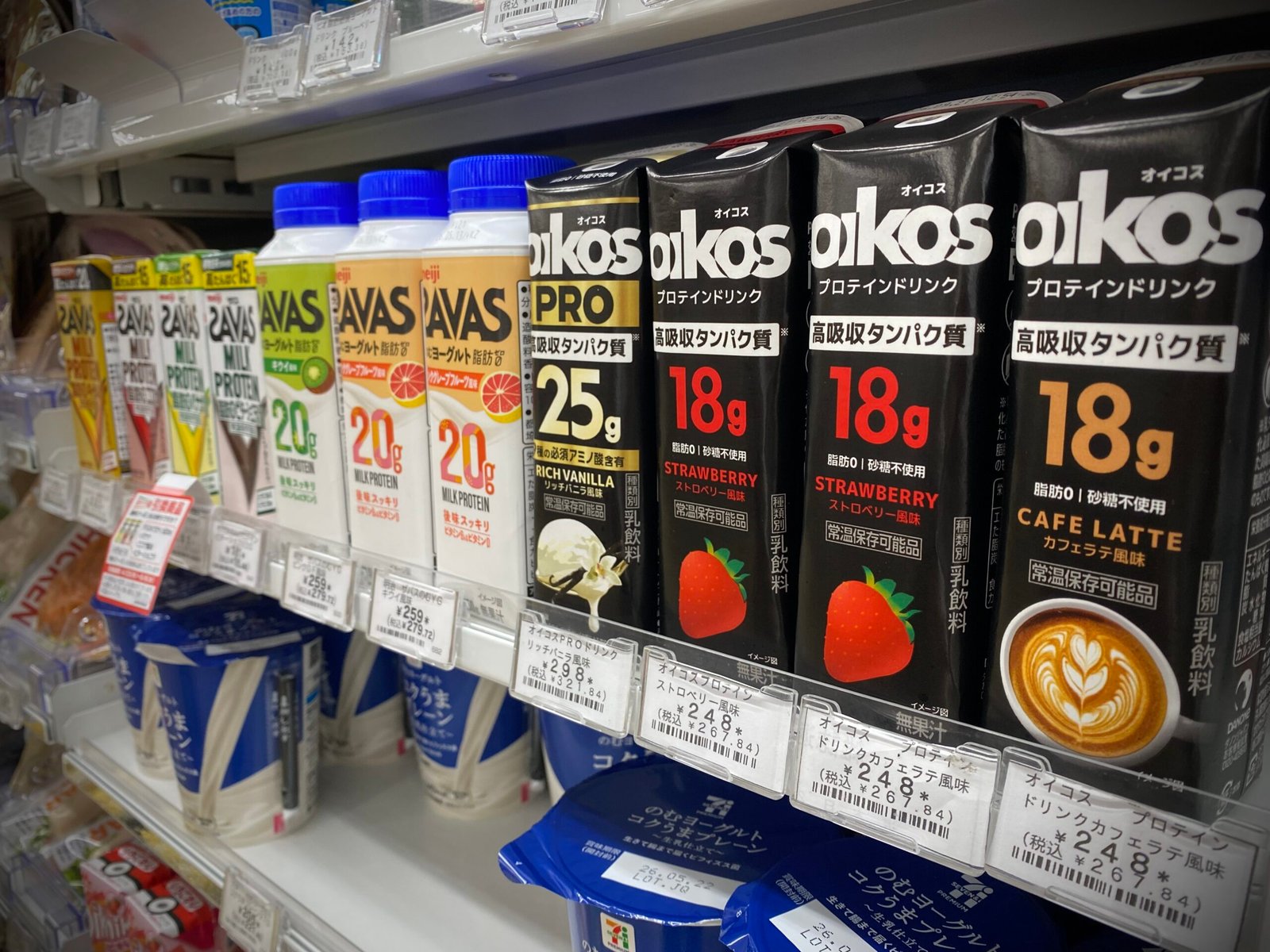
THE PROMISE OF PROTEIN
Protein has become the default signal for “better” food. You see it across almost every category — yogurt, cereal, snacks, ready meals — and the message is consistent: higher protein is positioned as an upgrade. In fitness contexts, this becomes more explicit. Daily protein intake is treated as a central variable, sometimes the central variable.
There is a sound basis for this. Protein supports muscle maintenance, contributes to satiety, and plays a meaningful role in how a diet holds together over time.
Most people have absorbed this idea. What has not followed is a clear way to evaluate what “high-protein” actually means in practice.
That gap is what this post is about.
- The Problem Is Not A Lack Of Protein
- The Model That Most Products Follow
- “High Protein” is a Signal, Not A Standard
- What Protein Actually Needs In Order To Work
- The Broader Pattern Behind This
- Why The System Keeps Producing Such Products
- What A More Useful Evaluation Looks Like
- Where Most High Protein Products Fall Short
- A Temporary Way To Navigate the Category
- The Label Brief Calculators
- THe Point Where this Should End
- The Takeaway
- Join the Newsletter
The Problem Is Not A Lack Of Protein
If you look at the current food landscape, there is no shortage of high-protein options. And if the logic were as simple as it is often presented, it would already look very different.
Protein bars, protein yogurts, protein cereals, protein desserts — the category has expanded rapidly. On the surface, this looks like progress. Better products exist. More choice exists… but the experience of eating these products often does not match the promise.
Some do not feel filling. Some feel engineered rather than satisfying. Some do not replace the foods they are meant to improve upon, they simply sit alongside them. This creates a contradiction.
If protein does what it is supposed to do, why does increasing it within a product not reliably produce a better result?
Want to refresh your memory on Protein and how to check it on a nutrition label?
How to Evaluate Protein in Any Food and Why Calories Are the Only Fair Comparison
The Model That Most Products Follow
To answer that, it helps to look at how these products are actually constructed.
The dominant model is straightforward: increase the protein content, make that increase visible, and allow the consumer to infer that the product has therefore improved. Once that condition is met, the rest of the product is often treated as secondary.
This works at the level of the claim. It does not necessarily work at the level of the outcome.
Because food is not experienced through a single variable, it is experienced as a whole. A product can be high in protein while also being high in total energy relative to its size, high in sugar or refined carbohydrates, low in fibre, and low in satiety relative to the calories it provides. None of these conditions cancel out the protein content, but they do change what the product actually does when you eat it.
The claim remains true, but the conclusion drawn from it often does not.
“High Protein” is a Signal, Not A Standard
Part of the difficulty is that the term itself sounds more precise than it is.
“High-protein” does not tell you how efficiently a product delivers protein relative to its calorie cost, it does not tell you what accompanies that protein, and it does not tell you whether the product is structurally balanced or skewed toward a single metric. Each product defines “high” in its own way and presents that definition as sufficient.
This is how a category becomes inconsistent while appearing consistent. The label looks uniform across products, but the underlying structure varies widely.
What Protein Actually Needs In Order To Work
Protein does not operate in isolation within the body, and this is where the gap between theory and product design becomes more visible.
Its contribution to satiety and diet stability depends on context: how much energy is required to obtain it, what other macronutrients are present, and how the food behaves in a normal eating situation rather than in a controlled comparison on paper. When protein is delivered within a structure that is already unbalanced – high energy density, low fibre, rapid digestibility – its effects are limited.
This is why a high-protein product can fail to feel filling and fail to support consistent eating. The protein is present, but the conditions that allow it to do its job are not.
The Broader Pattern Behind This
What is happening here is not unique to protein, it is an example of a broader pattern in how food products are designed and communicated.
A single metric is selected — low sugar, low fat, low calorie, high protein — and the product is built around that metric as the defining feature. Each of these variables can be meaningful, but none of them define quality on their own. When one metric becomes dominant, the others tend to drift, and the result is a product that performs well in one dimension while underperforming in others.
This is not a failure of protein as a concept. It is a limitation of single-metric thinking.
Why The System Keeps Producing Such Products
The reason this pattern persists is not difficult to understand once you look at how decisions are made in practice.
Single metrics are easy to communicate, easy to print on packaging, and easy to compare quickly in a retail environment where most decisions are made in seconds. A claim such as “high protein” is immediately legible in a way that a full nutritional profile is not.
So the system optimises for signals that are simple, even when those signals are incomplete.
What A More Useful Evaluation Looks Like
If the goal is to understand whether a high-protein product is actually an improvement, the comparison has to shift from presence to structure.
The question is not simply whether protein is high, but what it costs to obtain that protein and what comes with it. This brings multiple variables into view at the same time: protein relative to calories, fat content and type, sugar content, fibre content, and overall energy density.
Two products can carry the same protein claim and behave very differently once these factors are considered together. The difference lies not in the presence of protein, but in how that protein is delivered.
Where Most High Protein Products Fall Short
Once viewed through this lens, a consistent pattern emerges.
Many high-protein products deliver protein at a relatively high caloric cost, pair that protein with sugar or refined carbohydrates, and lack fibre, which weakens the satiety response that protein would otherwise support. Processing is often used to achieve taste and texture, which further shapes how the product behaves when eaten.
They meet the requirement to make the claim, but they do not meet the requirements to improve the overall outcome.
That is why they remain alternatives rather than becoming defaults.
A Temporary Way To Navigate the Category
At the moment, making this distinction requires looking beyond the front of the package and understanding how the numbers interact, which is not how most people want to make decisions and not how the system is designed to be used.
Tools like the Label Brief calculators exist to translate that information into a more usable form by placing those variables into a structure that allows for direct comparison across products. They do not provide a verdict, and they are not intended to replace judgment. They reduce ambiguity and are meant to be temporary by design.
The Label Brief Calculators
The Protein Index
How to Evaluate Protein in Any Food and Why Calories Are the Only Fair Comparison
The Fat Index
Why Fat Per Calorie Is the Only Fat Number Worth Looking At
The Sugar Index
Not All Sugar Is the Same And Your Nutrition Label Is Not Helping You Tell the Difference
The Fibre Index
Why Fibre Is the Most Underrated Number on Any Nutrition Label
The Volume Index
Volume Eating: Why Eating MORE Food Is Sometimes the Answer And How to Make It Work
THe Point Where this Should End
In a more coherent system, this level of analysis would not sit with the individual.
Products would be structured in a way that makes the better option consistent enough to become the default, and the need to decode labels or compare multiple variables at the point of purchase would fall away.
The fact that tools are useful at all is a signal that the system itself has not yet reached that point.
The Takeaway
Protein remains one of the most important variables in diet, but on its own it does not define food quality.
A high-protein label tells you something, but it does not tell you enough. Until products are built and evaluated in a way that reflects the full structure of food rather than a single metric, high-protein foods will continue to fall short – not because protein fails, but because the system around it does.
Want to eat better in a food environment that isn’t designed for it? That’s exactly what The Label Briefs is built around. Follow along as we break down what’s in your food, why the system works the way it does, and what you can actually do about it.
Join the Newsletter
Get the newest notes delivered to your email
.
SenT Only when there’s something worth sharing
the author

Mimi
founder
I experiment with building smarter eating habits that are relatively easy to implement and meant to help people feel better day to day and for the long-term.
Leave a Reply