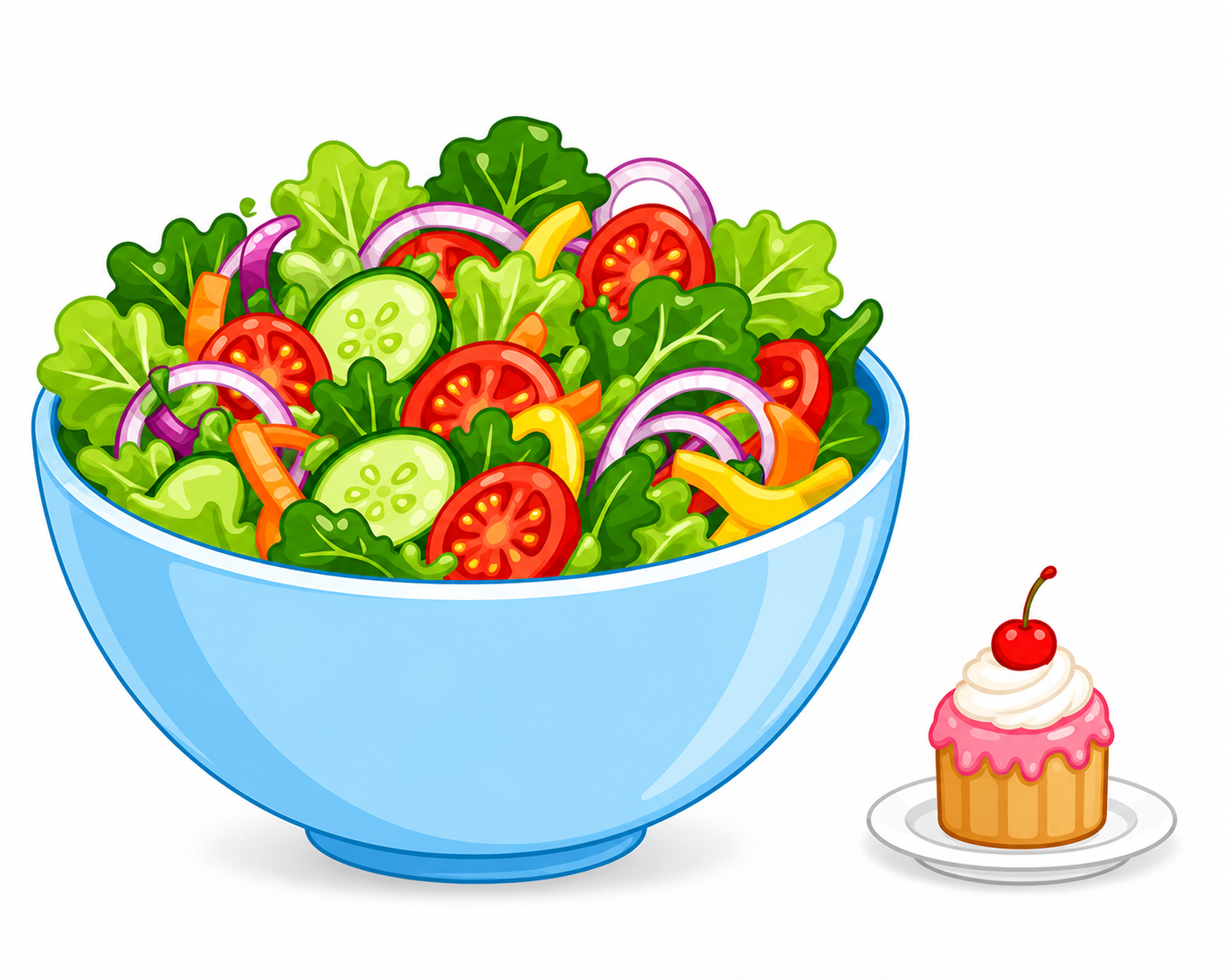
You can have two meals before you, with the same approximate calorie count, and have a completely different eating experience.

The first: a large bowl of mixed greens, cucumber, cherry tomatoes, a light dressing. It looks substantial. It takes a few minutes to work through. You finish it feeling like you have eaten something real. An hour later you are hungry again and thinking about a snack. The satiety is gone.

The second: a smaller bowl by comparison. Lentils, some roasted vegetables, a piece of grilled fish. It does not look like very much. You finish it in less time than the salad. Two hours later you have not thought about food once. Three hours later you are still fine. The aftermath of that meal feels different from the salad one.

Same calories, but completely different experiences of fullness.

If you have ever eaten a large meal and been hungry an hour later — or eaten something modest and been surprised by how long it held you — you have already noticed that something beyond size is determining how full you feel. The meal that held you was not necessarily smaller, but built differently.

Fullness is not a single event produced by a single variable. It is a sequence of overlapping signals that activate at different points in time — during the meal, in the hour after, and across the hours that follow. Each signal responds to a different nutritional variable. Volume is the first of them. Understanding what it does, what it cannot do alone, and what it needs alongside it is what this post — and this index — is actually about.
- The three stages of fullness and where volume fits
- Stage one: Volume – the entrance signal
- Stage two: Fibre and protein – the digestive tract
- Stage three: The full macro balance — biochemical satisfaction
- Volume eating done wrong VS done right
- How caloric density works on a label
- Where the base library ends and what comes next
- Join the Newsletter
The three stages of fullness and where volume fits
Most nutrition advice treats fullness as if it were a single thing that either happens or does not. You are full or you are not. Eat less, feel less full. Eat more, feel fuller.
The reality is more interesting and more useful than that. Fullness is produced by at least three distinct mechanisms that activate at different points in time: during the meal, in the hour after, and across the hours that follow. Each mechanism responds to different nutritional variables. And understanding which variable does what determines how to construct a meal that covers all three stages rather than just one.
Stage one: Volume – the entrance signal
The first fullness signal your body generates is mechanical. Your stomach contains stretch receptors — sensory cells in the stomach wall that respond to physical distension. As the stomach fills, these receptors send signals via the vagus nerve to the hypothalamus, contributing to the feeling of fullness in real time, during the meal itself.
This is volume’s primary job. A high-volume, low-calorie meal — the large salad, a bowl of broth-based soup, a plate of roasted vegetables — fills the stomach physically and activates the stretch receptor signal. Your body receives a message: the stomach is full. We have eaten.
But there is a second mechanism operating simultaneously that is worth paying attention to: the chewing signal.
High-volume foods — raw vegetables, whole fruits, leafy greens — require sustained chewing. The act of chewing for an extended period activates what are called cephalic phase responses: anticipatory digestive signals triggered not by nutrients entering the bloodstream but by the sensory experience of eating itself. Taste, smell, texture, the mechanical act of chewing — all of these send signals to the brain that food is being consumed. The longer the eating process takes, the more sustained and convincing that signal is.
There is something in this that goes beyond pure physiology. When you spend ten minutes working through a substantial volume of food — when eating feels like an event rather than a transaction — the brain’s perception of having eaten a proper meal is activated in a way that a quickly consumed, calorie-dense small portion does not reliably trigger. The monkey brain, for lack of a more scientific term, responds to the experience of eating as much as to the calories consumed. Volume provides that experience.
Lettuce is the clearest example of this. Lettuce is not particularly high in fibre. It will not produce significant GLP-1 stimulation. It will not slow gastric emptying like high fiber foods do. What it does is occupy physical space in the stomach, require sustained chewing, and create the sensory experience of having eaten a large quantity of food. Its satiety value is real, but it operates almost entirely at Stage One. Which is why the large salad leaves you hungry an hour later. The stretch receptor signal fades as the stomach empties. Without anything operating at Stage Two, there is nothing to sustain the fullness signal once the volume has passed through.
Stage two: Fibre and protein – the digestive tract
Once food leaves the stomach and enters the small intestine, the stretch receptor signal diminishes. The stomach is emptying. Volume’s job is largely done. This is the moment that determines whether a meal holds or collapses and it is entirely dependent on what fibre and protein are doing in the digestive tract.
As covered in the fibre post, dietary fibre stimulates the release of GLP-1 and PYY, satiety hormones that signal fullness to the brain with a longer half-life than the mechanical stretch receptor signal. Fibre also slows gastric emptying, the rate at which the stomach releases its contents into the small intestine, which extends the duration of Stage One even as it transitions into Stage Two. Protein amplifies both effects.
This is the mechanism that the large salad was missing. Greens and cucumber and cherry tomatoes are high in volume but modest in fibre and low in protein. The stretch receptor signal activated during eating. The hormonal satiety signal did not sustain. An hour later, the meal had passed through without leaving a meaningful biochemical signal in its wake.
The lentils and fish covered Stage Two. The lentils are among the highest-scoring foods on the Fibre Index – dense in soluble fibre that slows digestion and sustains GLP-1 activity for hours. The fish is high protein — among the highest-scoring foods on the Protein Index, which amplifies the satiety hormone response and further slows gastric emptying. The combination produces a hormonal fullness signal that outlasts the meal by hours rather than minutes.
Stage three: The full macro balance — biochemical satisfaction
The third stage is less about any single macro and more about the complete picture. A meal that covers Stage One with volume and Stage Two with fibre and protein is already a well-constructed meal. What makes it a genuinely satisfying meal – one that produces not just the absence of hunger but the positive feeling of being well-fed – is the integration of all the macros in proportions that meet the body’s full range of needs.
Healthy fat slows gastric emptying further and contributes to the duration of Stage Two. It also provides the fat-soluble nutrient absorption that a zero-fat meal cannot. Complex carbohydrates provide a steady glucose substrate for brain function without the spike and crash of refined carbohydrates. And the overall micronutrient density of a meal built from whole food sources means the body’s nutrient needs are being addressed alongside its caloric ones, which matters because hunger is not only a calorie signal. It is also a nutrient signal. A meal that delivers calories without nutrients leaves the body with an unfilled micronutrient need that can manifest as continued appetite even after caloric sufficiency has been reached.
This is the stage that ultra-processed foods fail most completely. They can be engineered to activate Stage One — large portions, substantial physical volume, extended eating time. They can partially address Stage Two through added fibre or protein. But they consistently fail at Stage Three because the nutrient density of manufactured products, however cleverly formulated, does not replicate the biochemical completeness of a meal built from whole food sources. The body can’t be cheated, it knows. And it will ask for more.
Volume eating done wrong VS done right
Diet culture’s version of volume eating usually stops at Stage One. Eat more low-calorie food. Fill your plate with lettuce. Trick your stomach into thinking it has been fed.
This works, partially, for the duration of the meal. It does not work for the hours that follow, which is why volume eating as typically prescribed produces the outcome described at the opening of this post: a large meal that leaves you hungry an hour later.
Volume eating done right uses high-volume foods at Stage One not as the primary satiety strategy but as the entry point to a meal that also covers Stages Two and Three. The large salad becomes a base that carries roasted legumes, a protein source, and a fat component — olive oil dressing, avocado, some cheese — that between them cover the hormonal and biochemical stages the volume alone cannot.
The Volume Index scores the first dimension of this. It tells you how much physical food you are getting per calorie — how effectively a food is earning its caloric cost through volume. A high score means more food, more stretch receptor activation, more sustained eating time per calorie. That is genuinely valuable. It is not, on its own, sufficient.
Read the Volume Index alongside the Protein Index and the Fibre Index. A food that scores well on all three — high volume, high protein, high fibre — is covering all three satiety stages simultaneously. It is, in practical terms, the most calorie-efficient construction of a satisfying meal available within the constraints of a real food environment. Lentils with vegetables and fish is not an accident of nutrition research. It is what the three indexes together point toward.
How caloric density works on a label
Most nutrition labels display calories per 100 grams as a standard column, which means the Volume Index’s quick mode requires no calculation at all. You read one number directly from the label and the calculator scores it immediately.
The floor is set at 10 kcal per 100 grams — the approximate caloric density of the least calorie-dense whole foods, like cucumber and lettuce — which scores near 100. The ceiling is set at 900 kcal per 100 grams — pure fat — which scores 0. The scale uses a square root curve that spreads score differences in the low-to-moderate caloric density range where most food decisions happen, and compresses them at the high end where the signal is simply “this is calorie-dense.”
Two notes are built into the calculator.
A high note above a score of 85 — below roughly 60 kcal per 100 grams — confirms very low caloric density and names this as a genuine satiety tool for Stage One.
A low note below a score of 45 — above roughly 400 kcal per 100 grams — flags high caloric density and explicitly names several of the foods in this range as nutritionally valuable in other dimensions, because the Volume Index is neutral and a low score here is not a verdict.
Unlike the Protein and Fibre indexes where higher is unambiguously better, and unlike the Sugar Index where lower is unambiguously better, the Volume Index is position-descriptive. It tells you where a food sits on the caloric density spectrum. Whether that position is desirable depends on what role the food is playing in your meal and your day.
Where the base library ends and what comes next
With the Volume Index, the five base indexes are complete.
Protein — measuring how efficiently a food delivers the macro most linked to satiety and muscle maintenance.
Fat — measuring fat density neutrally, with quality flagged separately.
Fibre — measuring the most underrated number on any label, with direction unambiguous.
Sugar — measuring sugar content in context, with natural and packaged foods interpreted differently.
Volume — measuring caloric density as the entry point to the satiety sequence.
Each index measures one dimension of a food’s nutritional value. Each is useful, but none is sufficient alone. A food that scores well on protein and poorly on fibre tells a different story from one that scores well on both. A food that scores well on volume and poorly on sugar tells a different story from one that scores well on both. The base indexes are the individual words, but you still need to string them together into a sentence – a complete meal.
The first combination is the Satiety Index — currently in development — which will weight protein, fibre, and volume together into a single composite score designed to answer the most practical question in everyday eating: will this meal actually keep me full?
It will not require you to run three separate calculations and synthesise the results. It will give you one number that reflects the interaction of all three variables — the hormonal signal, the digestive tract signal, and the entrance signal — as a single, comparable score across any food you evaluate.
That is what comes next. The base library is the foundation. The Satiety Index is where it starts to become a tool for real decisions in real food environments — the food court, the supermarket aisle, the convenience store between meetings.
The Volume Index calculator is in the Standards section, completing the base index library alongside Protein, Fat, Fibre, and Sugar.
Join the Newsletter
Get the newest notes delivered to your email
.
SenT Only when there’s something worth sharing
the author

Mimi
founder
I experiment with building smarter eating habits that are relatively easy to implement and meant to help people feel better day to day and for the long-term.
Leave a Reply to Why healthier versions of everyday foods remain scattered instead of the default – The Label Brief Cancel reply