And how we can start making changes
If you've been told that eating better is just a matter of trying harder, this one's worth reading.

In this post, we'll explore

(1) why healthy eating is shaped less by individual willpower and more by the environments we live in,

(2) how modern food systems influence our daily choices and health outcomes, and

(3) what shifting focus from personal discipline to environmental design means for building habits that actually last.

Foundational · 6 min read
- The Situation
- The “Traditional vs Modern” Confusions
- Preparation Matters More Than Origin
- Portion Sizes and Frequency
- The Rise of Ultra-Processed Foods Is GlobaL
- Marketing Shapes Perception
- So What Actually Determines Whether Food Is Healthy?
- The Real Issue: Environment, Not Ethnicity
- Why This Matters for Healthy Eating in Singapore
- Why the Myth Can Be Harmful
- Keeping the Foods We Love – Without the Side Effects
- Keep the Culture, Adjust the Defaults
- Join the Newsletter
The Situation
There is a persistent belief that Asian food is inherently healthier than Western food. In Singapore, this idea shows up everywhere — from hawker conversations to office lunches and even health advice online.
We picture bowls of rice and vegetables, light soups, and balanced home cooking, while “Western food” gets reduced to burgers, fries, and sugary drinks. I too a prone to resorting to that mental image.
But this contrast is misleading. It confuses cultural identity with nutritional reality and ignores how modern food environments actually work, especially in fast-paced cities like Singapore where convenience, affordability, and availability shape what we eat every day.
No cuisine is automatically healthy. Any cuisine can be cooked in a healthier way and also prepared in a very… not healthy way. These health outcomes are shaped less by geography or tradition and more by preparation methods, ingredients, portion sizes, frequency of consumption, and the surrounding food environment..
The myth persists because it is comforting. It suggests that culture itself protects people from diet-related problems.
Sure, culture influences food, but in the modern world where we no longer observe the seasons of food and shop local produce, our food environment is dictated and shaped by the industrial powerhouses that churn them out in the most efficient and cost-effective way. Which is not necessarily the healthiest way.
The “Traditional vs Modern” Confusions
When people say “Asian food is healthier,” they are usually imagining traditional home-cooked meals — not the full spectrum of what people actually eat day to day.
A typical weekday in Singapore might look familiar:
- kaya toast and kopi before work
- a quick hawker centre lunch — chicken rice, noodles, or curry eaten in under 20 minutes
- an afternoon bubble tea or iced latte between meetings
- dinner picked up from a mall food court or delivery app after a long day
None of these foods are inherently unhealthy. But neither are they automatically healthy simply because they are Asian.
The same distortion happens in reverse with Western food: critics picture fast food and ultra-processed snacks, not Mediterranean vegetable dishes, whole-grain breads, or home-cooked stews which still make up the daily fare of many living in European countries.
The comparison people often make is not fair. It is usually:
Traditional Asian home cooking vs. Industrial Western convenience food
A more accurate comparison would be:
- Traditional Asian home cooking vs. traditional Western home cooking
or - Industrial Asian convenience food vs. industrial Western convenience food
Once we compare like with like, the illusion begins to fade.
Preparation Matters More Than Origin
Many iconic Asian dishes are deeply flavorful and can be high in sodium, fat, or sugar depending on how they are prepared.
Across Singapore and Southeast Asia, common favourites illustrate this clearly:
- Deep-fried snacks from hawker stalls
- Coconut-rich curries and laksa
- Sweetened kopi and milk tea drinks
- Sodium-dense sauces and broths
- White rice forming the base of multiple daily meals
None of these are inherently unhealthy, and these foods are important parts of culture – but neither are they nutritionally light simply because they are Asian or part of culture.
The same is true of Western cuisines: olive-oil-based Mediterranean dishes, vegetable-heavy soups, and whole-grain staples can be nutritionally balanced, while fast food and processed snacks are not. It comes down to preparation. The above would already be so much healthier if small adjustments were made, like
- Deep-fried snacks → grilled or air-fried alternatives
- Rich coconut curries → lighter coconut milk versions
- Sugar-laden drinks → reduced or zero-sugar options
- Salty broths → lower-sodium variations
- Refined rice → mixed grains, legumes, or more vegetables
The cuisine itself isn’t the issue. How often and how heavily dishes are prepared is what matters.
Portion Sizes and Frequency
Another hidden factor is frequency of consumption.
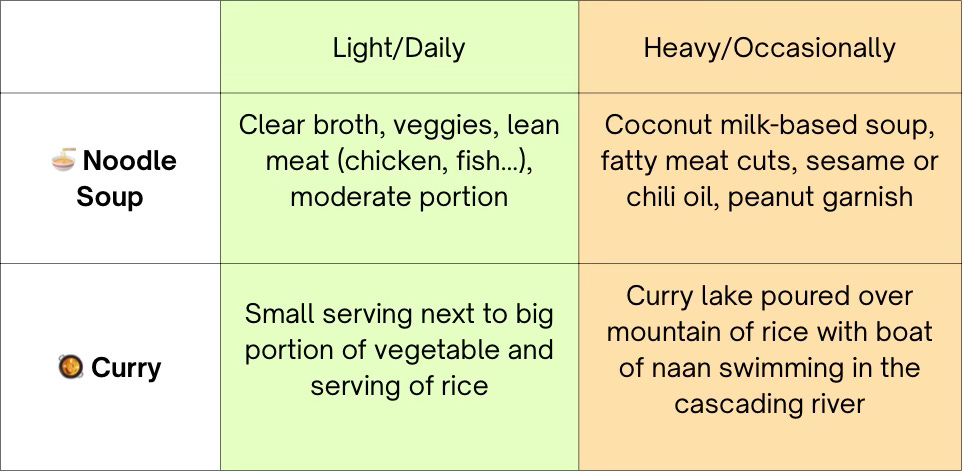
A rich coconut curry, eaten occasionally, prepared in the most traditional way, is not going to negatively affect your health. Eat it every single day, though? That’s when it becomes problematic.
In many Asian cities today, high-calorie beverages, refined carbohydrates, and fried snacks are widely consumed because they are affordable, accessible, and heavily marketed. The issue is not the cuisine itself but the shift in eating patterns driven by urbanization, time scarcity, and modern retail systems.
Traditional foods evolved in societies with higher physical activity levels and different energy needs. Our environments have changed faster than our habits.
Beyond the change in preparation of traditional foods, the broader food landscape in Asia has not remained immune to the offerings of international food conglomerates.
The Rise of Ultra-Processed Foods Is GlobaL
The industrial food system does not respect cultural or regional boundaries.
Walk through FairPrice, Cold Storage, or Don Don Donki and you’ll see how globalized food manufacturing has become: Packaged snacks, instant meals, sugary beverages, and heavily marketed “health” products now occupy large portions of supermarket shelves.
These ultra-processed foods are engineered for shelf life, hyper-palatability, and convenience. They often contain high levels of refined carbohydrates, added sugars, unhealthy fats, and sodium regardless of whether their flavor profile is “Asian” or “Western.” An instant curry cup or flavored seaweed snack can be just as processed as chips or frozen pizza.
Global food production has flattened nutritional differences between regions far more than most people realize.
Marketing Shapes Perception
Part of the myth of the inherent healthiness of Asian food survives because of branding and imagery. Words like “fresh,” “traditional,” or “authentic” evoke wholesomeness even when the nutritional profile is not particularly different from Western counterparts.
Consider traditional remedies such as Ginger Brown Sugar tea.
Prepared at home in the simplest way and consumed in moderation, it may provide the relief that they promise. Yet the commercial bottled versions of this tea often contain sugar levels far beyond what traditional preparation intended. This shows how traditional concepts are both taken to
(1) create mass commercial products, modified for taste and appeal, and
(2) market said creations as being equally healthy as their home-prepared counterparts, despite significant changes to their nutritional profile.
So What Actually Determines Whether Food Is Healthy?
Across all cuisines, the factors that influence health outcomes are remarkably consistent:
- Accessibility and price of healthier options
- Degree of processing
- Balance of macronutrients
- Fiber and micronutrient content
- Sodium and added sugar levels
- Cooking methods (steamed vs. fried, grilled vs. battered)
- Portion sizes
- Frequency of consumption
These determinants are structural, not cultural. They exist within food environments, not countries.
Fiber is a fiber, regardless of whether it is in Paris or Singapore.
The Real Issue: Environment, Not Ethnicity
When one cuisine appears healthier than another, it is often because the surrounding environment creates different defaults:
- smaller portion norms
- greater use of fresh ingredients
- social expectations around moderation
But as environments modernize through urbanization, supermarket expansion, and convenience culture, eating patterns shift accordingly.
This helps explain why many Asian countries, Singapore included, have seen rising rates of diet-related disease alongside increased availability of processed foods and sugary drinks.
The cuisine did not suddenly become unhealthy. The environment changed.
Why This Matters for Healthy Eating in Singapore
Singapore offers extraordinary food diversity, but also one of the most convenience-driven food environments in the world.
Long working hours, dense urban living, and easy access to prepared food mean meals are often chosen for speed rather than nutrition.
Healthy eating here becomes less about discipline and more about navigation: knowing what to look for, what small adjustments to make, and how to build better defaults within real life.
Why the Myth Can Be Harmful
Believing that a cuisine is automatically healthy can create blind spots and lead people to:
- underestimate sugar intake from drinks
- overlook sodium in sauces and broths
- assume traditional foods require no adjustment
It also oversimplifies public health challenges by attributing outcomes to culture rather than systems, policies, and market forces.
It can also foster complacency: tradition does not immunize food from modern processing or evolving consumption habits.
Keeping the Foods We Love – Without the Side Effects
So how do we keep our favourite foods and snacks in our diet without suffering the health side effects?
The goal isn’t to abandon favourite foods.
Take bubble tea – a daily ritual for many in Singapore. Many love to pick up one of those as an afternoon treat after work.
A jasmine milk tea with pearls or a brown sugar version with cream foam. Once a week, sure no problem. But let’s be real, we’re picking those up almost every single day.
Small adjustments make a big difference:
- request less or no sugar
- choose lighter toppings like aloe or grass jelly
- save indulgent versions for occasional enjoyment
For traditional meals, ask three simple questions:
- How is it prepared?
- How often am I eating it?
- What else is on the plate?
Individual ingredients are rarely the problem. Patterns are. Even beyond patterns, the big problem is the quantities in which the food industry serves us both the hyper palatable food combinations.
Keep the Culture, Adjust the Defaults
The goal is not to abandon traditional cuisine, but to separate tradition from habit.
Preserve flavors and cultural identity while adjusting portions, cooking methods, and side dishes to better match modern lifestyles that are often more sedentary than those of previous generations who needed the calories for their hard manual labour.
Treat tradition as inspiration, not a limitation.
Keep the flavours.
Keep the culture.
Adjust it a bit.
Want to eat better in a food environment that isn’t designed for it? That’s exactly what The Label Briefs is built around. Follow along as we break down what’s in your food, why the system works the way it does, and what you can actually do about it.
Join the Newsletter
Get the newest notes delivered to your email
.
SenT Only when there’s something worth sharing

the author

Mimi
founder
I experiment with building smarter eating habits that are relatively easy to implement and meant to help people feel better day to day and for the long-term.
Leave a Reply