
Struggling to eat healthy in Singapore? Science shows that the food environment – not willpower – is the real obstacle.

If you've tried to eat better and keep reverting to old patterns, this one is for you.

In this post, we'll explore

(1) why the science increasingly points to food environments, not willpower, as the primary driver of what we eat and how much we weigh,

(2) what Singapore's specific food landscape - hawker centres, convenience stores, supermarket design, and delivery apps - actually looks like through a nutritional lens, and

(3) what shifting focus from personal motivation to environmental design means in practice, including concrete changes you can make this week.

Foundational · 6 min read
- The Situation
- What the Evidence Shows: Food Environments Shape What You Eat
- Singapore’s Specific Food Environment
- What Ultra-Processed Food Actually Is — And Why It’s Everywhere
- Why Willpower Fails – The Mechanism, Not Just the Fact
- What Actually Changes Behaviour: Environment Design, Not Motivation
- The Takeaway
- Join the Newsletter
- References
The Situation
Picture a typical lunch run. It’s 12:30pm. You’re standing in a food court – maybe it’s the one below your office, maybe it’s in a shopping mall – and you’re scanning the stalls.
There’s char kway teow, laksa, nasi lemak, a wonton mee stall, a Western fast food counter, a bubble tea shop. There is, perhaps, one stall with a roughly “healthy” option, and it costs more, has a longer queue, and if you’re honest, is less satisfying than what’s next to it. You make a choice. You tell yourself you’ll do better tomorrow.
Tomorrow arrives. The food court is the same.
If you’ve tried to eat better and keep falling short, the standard story says you lack discipline. You need more willpower. You just don’t want it enough.
But a substantial and growing body of scientific research points to a different explanation: the food environments most of us live and work inside are structurally designed – whether by intention or by market forces – to make unhealthy eating the default. Not because of your choices. Because of the system those choices happen inside.
Understanding healthy eating through this structural lens shifts everything: how we diagnose the problem, how we stop blaming ourselves for it, and, crucially, what we can actually do about it.
What the Evidence Shows: Food Environments Shape What You Eat
The term food environment refers to all the external factors that shape what’s available, accessible, and affordable to you – from the density of fast food options around your office, to the placement of snacks near checkout counters, to the pricing gap between a plate of economical rice loaded with fried options versus a balanced meal with lean protein and vegetables.
Large-scale studies have shown that what’s physically present in your environment is one of the strongest predictors of what you eat – and it is more powerful than individual motivation or knowledge:
In a nationally representative U.S. study, adult diets and excess weight were linked not just to individual behaviour but to features of the home food environment – the availability of fruits and vegetables versus salty snacks and sugary beverages.
Greater variety of fruits and vegetables was associated with higher intake and lower odds of overweight or obesity; environments loaded with less healthy options were linked to poorer outcomes.
The logic extends directly: if home pantries shape outcomes, the supermarket, the hawker centre, and the office food court do too.
A separate line of research confirms that neighbourhood food access – supermarket density, proximity to healthy retailers – predicts dietary quality. Adults in areas with fewer supermarkets were significantly less likely to achieve a healthy diet, regardless of their personal motivation.
Across the globe, higher quality food environments with better availability, affordability, and accessibility are consistently associated with more diverse, nutrient-rich diets. In both Ethiopia and China, households in better food environments had substantially higher dietary diversity scores and greater intake of fruits and vegetables.
The core finding across all of this research is straightforward: context shapes choices. When healthy options are not available or affordable, even motivated, health-conscious people are constrained. Willpower cannot conjure a salad where none exists – and it cannot make the salad cheaper than the fried rice next to it.
Singapore’s Specific Food Environment
The global evidence matters. But what does Singapore’s food environment actually look like?
Most Singaporeans eat out for the majority of their meals. The hawker centre – rightly celebrated as a cultural institution and a UNESCO-recognised part of our heritage – is also, nutritionally, a heavily refined-carbohydrate, high-sodium, fried-food landscape. The average hawker meal is not designed around balanced macronutrients or micronutrient density. It is designed around flavour, price, speed, and throughput.
This is not a criticism of hawker culture. It is an observation about what the structural food environment looks like for the majority of Singaporeans on a typical day. When you eat out three times a day, your food environment is not your kitchen… it’s the stall in front of you. And the economics of that stall are not oriented toward your metabolic health.
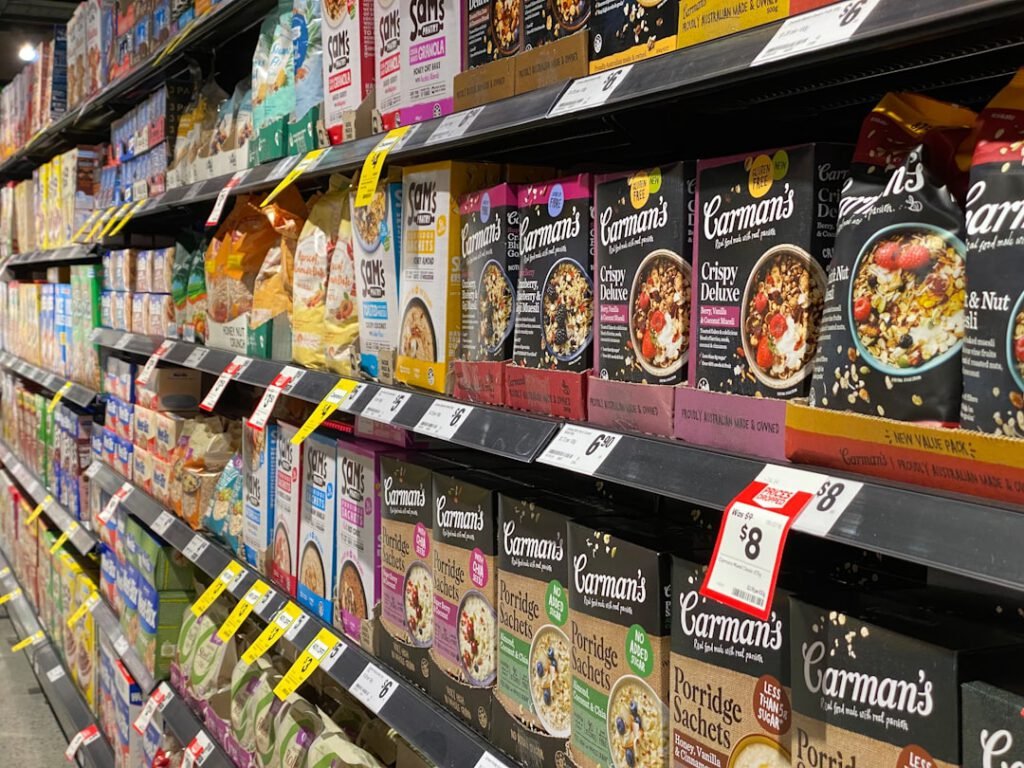
Layer on top of this: the density of convenience stores (7-Eleven, Cheers, FairPrice Xpress) stocking walls of ultra-processed snacks and sweetened beverages; the prevalence of food delivery apps that surface the most popular (and typically most calorie-dense) options first; the design of supermarkets where processed, packaged foods occupy the majority of shelf space while the produce section is comparatively modest. The result is an environment where, at nearly every decision point, the path of least resistance leads to something heavily processed, calorie-dense, and nutritionally thin.
The Health Promotion Board’s National Nutrition Survey has repeatedly found that Singaporeans consume excess sodium and saturated fat and fall short on fruit and vegetable intake. These are not findings about individual choices made in a vacuum. They are findings about what is available, affordable, and convenient to the people living here.
What Ultra-Processed Food Actually Is — And Why It’s Everywhere
Before going further, it’s worth being clear about what ultra-processed food actually means… because it’s not just “junk food.”
Researchers use the NOVA classification system to categorise foods by how much industrial processing they’ve undergone. Ultra-processed foods (Group 4) are not made from real ingredients combined in your kitchen or a restaurant. They are manufactured using industrial processes and typically contain ingredients you wouldn’t find in a home pantry: emulsifiers, flavour enhancers, colour additives, hydrogenated oils, and various forms of processed sugar. Think instant noodles, flavoured yoghurt drinks, breakfast cereals, packaged crackers, most fast food items, sweetened beverages, chicken nuggets. In Singapore, these products are everywhere — and they are priced, positioned, and marketed to be the default choice.
Public health researchers have described many modern food markets as toxic food environments – a term coined by Kelly D. Brownell – to describe settings that actively promote overconsumption of these products.
These products are engineered to be hyper-palatable, meaning they’re specifically designed to override the normal satiety signals your body uses to stop eating. They are also designed to look appealing: bright packaging, prominent placement at eye level, heavy marketing spend. The produce section, by contrast, is modest, quieter, and priced at a premium. This is not accidental. It reflects decades of investment by food manufacturers in understanding exactly how to get people to buy and consume more.
Multiple clinical studies have shown that diets high in ultra-processed foods lead to significantly higher calorie intake and weight gain, even when total macronutrients are matched between groups.
Beyond calories: even when caloric intake is held constant, highly processed diets appear to produce worse health outcomes than minimally processed ones through mechanisms that researchers are still mapping, including effects on the gut microbiome, hormonal signaling, and nutrient bioavailability. The food itself, not just the quantity of it, appears to matter.
Why Willpower Fails – The Mechanism, Not Just the Fact
Most people who struggle with their diet know, at some level, what they should be eating. The problem is rarely ignorance. Surveys consistently show that large majorities of people want to eat healthier and understand the basics of good nutrition. Yet nutrition education alone has repeatedly produced limited, short-lived changes in behaviour.
The reason is what researchers call decision fatigue. Every food decision you make – every time you walk past a vending machine, scroll a delivery app, or stand in a food court – draws on a finite cognitive and motivational resource. In an environment saturated with engineered, hyper-palatable, heavily marketed food options, you are making dozens of these decisions daily. Willpower is not a character trait. It is a resource that depletes. And it is being systematically drained by an environment built to drain it.
This is sometimes described as choice architecture: the implicit design of environments that frames decisions before they’re consciously made. When the cheapest, most visible, most convenient option is always a calorie-dense ultra-processed product, the default has been set for you. Overriding it requires conscious effort every single time. The default only has to win once.
What Actually Changes Behaviour: Environment Design, Not Motivation
If environments shape behaviour more powerfully than education or willpower alone, then improving dietary outcomes requires changing environments, not just encouraging people to try harder.
Research on environmental and policy interventions confirms this. Systematic reviews find that altering food environments (through retail food policy, pricing incentives, or redesigning school and workplace food settings) produces measurable shifts in population dietary patterns.
School food environment interventions, for example, have shown meaningful improvements in children’s diets. Pricing incentives that make healthy foods more affordable consistently increase their uptake. The mechanism is always the same: change what’s default, and behaviour follows.
At the individual level, the same logic applies. The most durable changes are environmental, not motivational. Some concrete examples of what this looks like in a Singapore context:
- Control your home pantry deliberately.
Research consistently shows that what’s physically present in your home is among the strongest predictors of what you eat. If processed snacks and sugary drinks are not in your fridge and cupboards, you will not eat them when your willpower is low at 10pm. This is not a discipline strategy. It is an environmental one. - Apply a default rule at the food court.
Rather than evaluating every option from scratch each time, pre-decide a simple rule that works for you — for example: always choose a protein and vegetable over a carbohydrate-only dish, or always avoid anything fried as the main component. A pre-set default is far more robust than in-the-moment decision-making in a high-friction environment. - Read the ingredient list, not just the nutrition label.
Ultra-processed foods are often disguised behind acceptable macro numbers. A product with five grams of sugar and reasonable calories can still be heavily processed. If the ingredient list is long and contains things you wouldn’t cook with, it’s probably ultra-processed regardless of what the front-of-pack claims.
The Takeaway
None of this is an argument for passivity. Individual choices matter. What you eat tomorrow matters. But those choices happen inside a system … and that system, in Singapore as much as anywhere else, is currently oriented against your health. Telling people to work harder inside that system, without acknowledging the system itself, is like telling swimmers to try harder in a riptide.
The goal is not to give up on personal effort. It is to redirect that effort toward things that actually work: designing your environment, understanding what’s in your food, building defaults that protect you when your motivation is low. And, beyond the individual, pushing for a food landscape that makes healthy eating the easy choice rather than the effortful one.
That is what The Label Briefs is building toward. We write about the food system as it actually is, not as it’s marketed to you. We share what the research shows. And eventually, we will curate and create products that meet a different standard – one where the default choice is also the healthy one. Follow along.
Want to eat better in a food enviraonment that isn’t designed for it? That’s exactly what The Label Briefs is built around. Follow along as we break down what’s in your food, why the system works the way it does, and what you can actually do about it.
Join the Newsletter
Get the newest notes delivered to your email
.
SenT Only when there’s something worth sharing

References
Gamba RJ et al. Measuring the food environment and its effects on obesity. Eating Behaviors. 2015.
Health Promotion Board. National Nutrition Survey. Singapore.
Larson N et al. Neighbourhood environments: disparities in access to healthy foods in the US. American Journal of Preventive Medicine. 2009.
Laska MN, Hearst MO, Forsyth A, Pasch KE, Lytle L. Neighbourhood food environments: are they associated with adolescent dietary intake, food purchases and weight status? Public Health Nutr. 2010 Nov;13(11):1757-63.
Micha R et al. Association Between Dietary Factors and Mortality From Heart Disease, Stroke, and Type 2 Diabetes in the United States. JAMA. 2017.
Monteiro CA et al. NOVA classification system. The NOVA food classification and the trouble with ultra-processing. Public Health Nutrition. 2018. 21(1):5-17.
Swinburn B et al. The global obesity pandemic: shaped by global drivers and local environments. The Lancet. 2011.
the author

Mimi
・
I experiment with building smarter eating habits that are relatively easy to implement and meant to help people feel better day to day and for the long-term.
Leave a Reply